Wednesday, October 7, 2015

Creating the Ideal Classroom Environment

What is motivation?
Motivation is defined as “the general desire or willingness for someone to do something" 
Now imagine if that something was learning...the possibilities in the classroom would be endless!


As educators, it is important to recognize that an unmotivated student will not learn effectively. Motivation directly affects the students' learning and behaviour. Ormrod (2014) explains that students strive when they set goals for themselves. Motivation is the factor which allows them to set these specific goals. It also leads to increased energy and effort, and the more motivated they are, the more enthusiastically they will pursue a particular task. Motivation also increases initiation and persistence in activities. When students start a task they want to do, they will be likely to stay on task. Lastly, motivation affects cognitive processes. Motivated learners make an effort to pay attention, and meaningfully understand the material (Ormrod, 2014).


Consequently, I believe that a key priority for every teacher should be to create an engaging environment which can inspire students. Not only is motivation rewarding for the students, but it is just as exciting for the teachers when the students are invested in their learning ("Motivating Students", n.d.).


Before I discuss ways to motivate students, I think it is important to recognize reasons why students may be unmotivated. However, be careful not to confuse a student who is having difficulty learning as being unmotivated. 


Reasons student may not be motivated include:
  • Lack of interest in the subject
  • getting distracted by external forces
  • being unengaged by the teacher’s practices ("Motivating Students", n.d.)

The image below demonstrates the different ways a classroom environment can be modified to motivate students. 


A key point to remember is that every student will be motivated in one way or another! Teach.Com provides some great tips on how to get your students excited about learning. These tips include:

1. Encouraging Students:
Students really value a teacher's opinion. A little recognition can go a long way when a student feels valued and respected. 

2. Get your students involved
If students are given responsibilities, it provides them with a sense of accomplishment and makes them feel like active members of the learning process. 

3. Offer incentives
It is important to set expectations and encourage participation, but sometimes that is not enough. Rewards and incentives give students that extra push, and it can provide a sense of pride when the goal is accomplished. 

4. Get Creative 
As an educator, try to steer away from a singular teaching practice. Be flexible with your methods, and don't be afraid to bring in visual aids, games, and to enhance the teaching. 

5. Draw connections to real life  
Give the students a reason to believe that what they are learning is important. When you explain how the material applies to them, and how it can relate to their life, they will be much more attentive. ("Motivating Students", n.d.) 

Lastly, for those of you are interested in a few extra strategies to increase student engagement, I have attached a video clip with 7 great tips! 


[Reading Horizons]. (2014, January 3). 7 ways to increase student engagement in the classroom [Video file]. Retrieved from https://www.youtube.com/watch?v=TjADkTe5upA


References: 
Motivating Students. (n.d.). Teach.com. Retrieved October 5, 2015 from http://teach.com/what/ teachers-change-lives/teachers-motivate
Ormrod, J. (2014, April 30). How Motivation Affects Learning and Behavior. Retrieved October 5, 2015, from http://www.education.com/reference/article/motivation-affects-learning-behavior/
Strong, R., Silver, H., & Robinson, A. (1995). What do students want (and what really motivates them)?. Strengthening student engagement. 53 (1), 8-12. Retrieved from http://www.ascd.org/public ations/educational-leadership/sept95/vol53/num01/Strengthening-Student-Engagement@-What-Do-Students-Want.aspx

Wednesday, September 23, 2015

Holistic Curriculum

Imagine the possibility of an enriching educational experience which encompasses your body, mind, and spirit! Although it may sound a bit far-fetched, this model of teaching is actually practiced through the Holistic Curriculum. The Holistic Curriculum goes beyond the traditional scope of direct instruction where teachers deliver instruction, and students learn. This model reflects many of the practices of constructivism and works on the basic understanding that the student’s mind, heart, body and spirit should be engaged in daily learning (Drake et al., 2014).

I find that this method could be extremely effective because as I get closer to my goal of becoming a teacher, the more aware I become of how many flaws there are in the traditional classroom. Students are not being engaged, which is holding them back from reaching their maximum potential. School should be an environment which sparks their interest, not just a place they attend through obligation. What really appeals to be about holistic education is that it appeals to people intrinsically. By being directly engaged with their environment, students are able to find meaning and purpose (Miller, 2000). It instils a sense of “wonder” into students, which makes them want to learn.  Below, you can see staff and parents explaining their experience of being involved with a holistic model of education at Success Academy, in New York. 

[SuccessAcademies]. (2012, February 23). The Success Academy Approach to Teaching and Curriculum [Video File]. Retrieved from https://www.youtube.com/watch?v=LN-bjKTsLy8

The basis of this school curriculum really appealed to me, but I found it difficult to actually understand how this model of education would be practiced.  I then came across the website for Equinox School, which is a Toronto public school which utilises a holistic approach. The goal is to “promote the development of healthy, responsible, inquisitive, creative human beings” (Equinox Holistic Alternative School, 2015).  The school understands that community connections are crucial because the first experience of community that a child experiences is in the classroom, and it can extend to local and global communities. By providing community building programs, students are instilled with the skills to take social action.  These skills are taught through the social studies program (Equinox Holistic Alternative School, 2015). It amazes me that children as young as elementary school are equipped with skills that I never gained throughout my entire education. The science curriculum encompasses developing a strong connection to earth through activities like gardening and farming which exist through a collaboration with community farms and gardens within the community. These partnerships allow students to gain the same knowledge other students receive through a hands on approach while empowering them (Equinox Holistic Alternative School, 2015). Another key concept of this which appeals to me is teachers accommodating differences by refusing to label children. Something as simple as bringing out the strengths of a student within a child's spirit can lead to providing them with a strong foundation, and allowing them to embrace their uniqueness (Miller, 2000).  
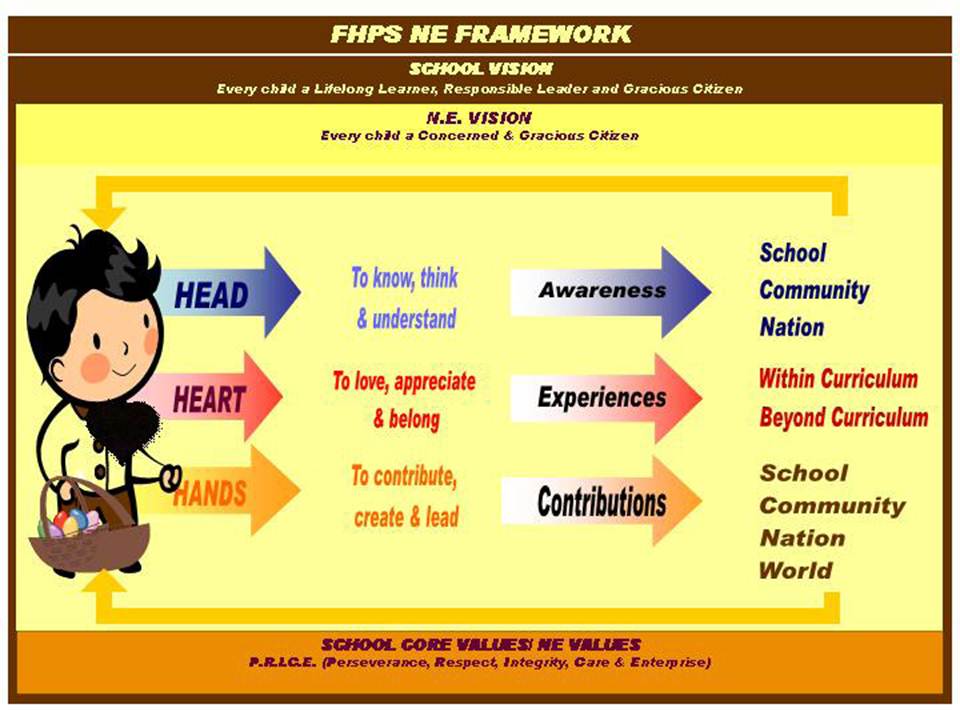
Below, you can view a visual example of an educational framework which is  implemented in a school which models the holistic curriculum. This vision comes from a school in Singapore. 
Fuhua Primary School. (2012). FHPS NE Framework [Online Image]. Retrieved September 21, 2015 from http://fuhuapri.swiiit.com/cos/o.x?c=/wbn/pagetree&func=view&rid=1152089

It reinforces that alternative schools still expect students to excel academically by creating life long learners. However, they go beyond that by equipping the students with the skills they need to be strong leaders, and gracious citizens. Overall, I think that educators need to get past the scepticism of how different this model is, and instead place an emphasis  on the advantages that arise from it, and include some of these practices in their own teaching. 


References


Drake, S., Kolohon, W., & Reid, J. (2014). Interweaving curriculum and classroom assessment: Engaging the 21st century learner (1st ed.). Don Mills, Ontario: Oxford University Press. 
Equinox Holistic Alternative School. (2015). Retrieved September 20, 2015. Retrieved from http://equinoxschool.ca/about/the-holistic-curriculum
Miller, R. (2000). ‘A brief introduction to holistic education’, the encyclopaedia of informal education. [http://infed.org/mobi/a-brief-introduction-to-holistic-education/. Retrieved: September 21, 2015.